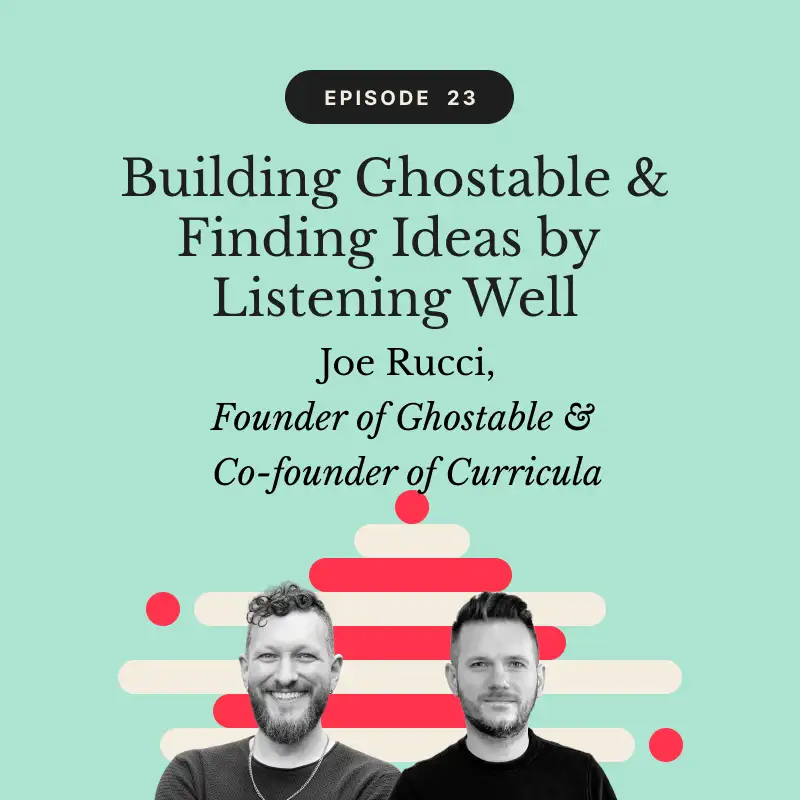
Building Ghostable & Finding Ideas by Listening Well | Joe Rucci, Founder of Ghostable & Co-founder of Curricula
Matt Stauffer:
Hey, and welcome back to the Business of Laravel podcast, where I talk to business leaders who are working in and with Laravel. My guest today is Joe Rucci, founder of Ghostable and co-founder of Curricula. Joe, would you introduce yourself and tell us who are you and what's your business?
Joe Rucci:
Yeah, thanks for having me, by the way. Yeah, my name is Joe Rucci. I'm the founder of Ghostable, a zero-knowledge security platform helping engineering teams securely manage and share environment variables across their tech stack. Before that, I was the co-founder and CTO of Cybersecurity Education Startup Curricula. And we would train businesses on a range of sizes from Fortune 500s all the way down to startups with maybe one or two employees.
Matt Stauffer:
Yeah. And so that gives us kind of at least two spaces for conversation here, which isn't always the case. We've got the, you know, founding and successful exit of something that is a little bit less than the tech space, which as I told you at the beginning, you know, before we recorded, I'm often trying to focus on, you know, podcast guests who are not just developers, working developers. But then we've also got, I think a lot of people are developers building products for developers. And because I told you before, I was like, there's so many of them that I'm wary about having too many on.
But you are a successful seasoned entrepreneur having built and sold things before. So I think that your take and your approach to building developer software is a little bit different and unique. So I'm excited to hear about how all of our topics of conversation kind of like are relevant on both of those. Off the bat, you the first question I always ask is, you know, like how is Laravel involved in your business? And I'm super curious for both.
Let's start with curricula and then, I do want to hear the same answer at Ghostable. Well, and I want to hear more about the pitch about what each of those are as well.
Joe Rucci:
Yeah, so with Curricula, my experience started with Laravel in 2015 when we launched the company. We were getting ready to do this. the, you know, of the four founders, I was the technical one. So it's like, okay, the sort of software side is on me. I'm trying to think of a framework, like which one are we gonna choose? You know, there was a lot of different choices. I was probably most proficient or felt most proficient in PHP.
It was kind of like, should I use code igniter? Because I had used that before in the past. And then there was Laravel and it was, you know, it's not new. think it was on maybe version four or something like that at the time. But the documentation struck me as being like just so beautiful to look at. I'm thinking to myself, like if I have to look at something every day, because it's going to be, you know, I'm committed to this company. Right. So like this is going to be an everyday part of my life. I just felt like Laravel was the right way to go at the time. And that's kind of how I got started with it.
Matt Stauffer:
Okay.
Joe Rucci:
I think my experience as a developer wasn't necessarily far off. I'm not school-trained as a developer. I didn't go to college for this. It's more of like, I want to build things. How do I get access to the tools that help me build those things? And I saw Laravel as really that sort of jumping off point as how to get me there. So yeah, first, I would say, five years of Curricula, I was the solo developer.
Matt Stauffer:
Okay.
Joe Rucci:
I'm kind of learning Laravel, learning how all this stuff connects together and figuring out all the server side on my own, which is difficult. We were running Forge at the time. So we've got load balancers and app servers, and now we're spinning up worker servers to do some of this stuff. And it was a lot. It was like a decent amount of overhead. Not that Forge isn't awesome. It makes that process pretty easy for one person to feel comfortable trying to sell something that's running on all this. But...
Matt Stauffer:
Yeah.
Joe Rucci:
But yeah, it's a lot for any one person to do. And I think when that started to hit our breaking point where I was like, I'm kind of losing sleep over this on a daily basis now, we started to see rumblings of like, hey, this Vapor thing is gonna come out. And then we kind of switched. I think we were one of the first maybe 10 people using it, which was really cool. And yeah, and so we rode that wave. And I feel like a lot of the success of Curricula over the time span has really just lined up with some of the.
Matt Stauffer:
Yeah, you were. Yeah.
Joe Rucci:
you know, like growing and success of Laravel as a framework.
Matt Stauffer:
That's awesome.
Joe Rucci:
So yeah, like I tell people, you know, no joke, like a big part of our ability to do that from an engineering point of view was as a result of picking Laravel. So it was like the first call I made as CTO and probably maybe my smartest one.
Matt Stauffer:
I love that. so you and I met in 2020. When did it actually get to the point where you guys were taking paying customers?
Joe Rucci:
So the first 12 months was all kind of build. We were working on some of the software. like my day would basically, I'd wake up, I draw and I paint and a big part of the Curricula story is creating these like educational cartoons that would teach people, you know, the ins and outs of having to avoid hackers and things like that. So we kind of dreamed up these like family guy style cartoons and they're kind of like cutesy, you know, cartoon-esque things. It's a big departure from your classic.
Matt Stauffer:
cool.
Joe Rucci:
security awareness training, is, yeah, which is, very dry.
Matt Stauffer:
Security training, yeah, uh-huh.
Joe Rucci:
It's very like, you know, you're just kind of sitting there staring at the screen, waiting for it to be over so you can go about your day. So we were like, okay, how do we change that? How do we make this like entertaining, but then also like sneak in meaningful information that actually does make people's like day to day safer. So the, so the business, you know, sort of domain information of cybersecurity came from my co-founder, Nick Santora. And then a big part of the creative side came from myself and another founder, Danny. And putting that together, it was like in the mornings I would draw cartoons, I draw episodes and storyboard them. Danny would do a lot of the animation. And then at night I would work on the Laravel side of the platform as a way of just distributing the training material. You could think of it as like an LMS in the beginning, similar to like a Laracast, know, not nearly as like polished or cool in the beginning, but, essentially the same kind of an idea, it's like an LMS to deliver the content.
Matt Stauffer:
Yeah. I had no idea you were doing creative at the same time. I just knew you're the tech guy. So that's amazing.
Joe Rucci:
Yeah, it was lot of fun to kind of go back and forth between that. I think for me, I felt like I was more of a creative person in the start. And it was like the engineering side was something I'm doing out of necessity. And then by the time we were acquired, it was more like, wow, I feel more like an engineer than I feel like I'm a part of the creative team now. We sort of hired up on that side. And so it sort of flipped for me, whereas now I feel more of an, you know
Matt Stauffer:
Mm-hmm.
Joe Rucci:
connection to the engineering end of it.
Matt Stauffer:
So how big was the engineering team when you sold?
Joe Rucci:
When we sold, we were only four engineers. So yeah, super lean. We've always tried to do it. From the very beginning, we've tried to be lean. I think a lot of startups, especially when they do around, they are quick to hire up these huge teams and there's nothing against people. Like I don't wanna make it sound like I'm against hiring, but I think you wanna do that in a careful and thoughtful way.
Matt Stauffer:
That's insane. Yeah.
Joe Rucci:
because you can really, you you can go underwater quickly when you have, you know, even just on one round, you can easily go underwater. And unless your goal is just to keep doing more and more rounds, I think you want to, you know, just be careful with that and make sure you grow at a pace that's working with the business. Engineers are expensive, especially the ones I'm going to hire. You know, I want to get some of the best of the best. I'm not super into the idea of like, well, you know, hire them at a lower level and then try and train them up. It's like, you know, I need someone to train me, right? Like I need someone to make
Matt Stauffer:
Yeah.
Joe Rucci:
that has to put me to shame, right? So that's the team that we did is we hired a smaller group of A-list engineers and it really paid off because we were able to have that kind of success but with a super tiny team.
Matt Stauffer:
Yeah, so you guys both took funding and also sold on Laravel and I've dealt with enough PEs and VCs and stuff like that that I've, you know, been in a lot of the conversations for, well, you can't use PHP, right? It's this outdated thing from the 90s. How much pain did it cause you to be on PHP?
Joe Rucci:
Yeah.
I do remember like during the rounds, right? When we were kind of going through that process, I don't know that if you've done it, but it's a lot of like road shows, right? Like you gotta talk to a million people, that just gets you in the door and then they wanna do like a technical due diligence. And a lot of times you would find there's some hesitant nature with that because they're kind of thinking, well, okay, PHP, yes, is it too old school?
Matt Stauffer:
Yep.
Joe Rucci:
I mean, obviously, I think we can agree that that's kind of a ridiculous idea. mean, half the Internet is powered by PHP. I think we're in good company in that sense. But yeah, it definitely comes up. mean, luckily, I think at least with our private equity people, they were smart enough to not care. They were like, yeah, I couldn't care less. Like it's a numbers game. How does this work? Do I have confidence in the founders? And that's the only reason I'm putting the money down. And so for that, that, you know, they were on board. But yeah, there's definitely a lot of pushback with that.
Matt Stauffer:
Does it do the job? Yeah.
Joe Rucci:
And the same for the acquisition, honestly. We were acquired by a Maryland-based cybersecurity unicorn now called Huntress, and they were also very smart with that. They were not a Laravel shop or a PHP shop. They were using Ruby. Yeah, and so they, yeah, they saw us and they were like, okay, it's PHP. That's fine. It's kind of siloed as a product. We were kind of coming on board as its own skew. So I think there was a little bit of a natural fit there.
Matt Stauffer:
Yeah.
Matt Stauffer:
Yeah, I didn't think they were. Okay, you know.
Joe Rucci:
But we were able to integrate the two fairly well. And as they sit, even today, know, one's PHP, one's Ruby. So it hasn't really affected them.
Matt Stauffer:
Okay, yeah. It's funny because when I heard Huntress, was like, I know of Huntress as I don't often have people very closely tied to their technology, but I was like, they are Ruby people. So I thought that was really cool to learn. So, I mean, I want to talk more details about curricula, but let's let's give it a pause. Let's talk about Ghostable. So acquisition happened before we talk about the specifics Ghostable. What was your life transition from, you know, having devoted so much time and energy into Curricula to acquisition? What did you do next?
Joe Rucci:
Yeah. Yeah.
Joe Rucci:
Yeah, so part of the acquisition was a two year contract to kind of go with Huntress and kind of be a part of the merging of the two companies and make sure that the technology handoff was smooth. So I kind of fell back into the same role even after the acquisition of like, I'm basically still working at Curricula, but now it's under, you know, sort of new management, so to speak. So it's definitely a change of pace, I think, from a founder perspective to go from like, I'm the owner of the company, you know, I make the call.
Matt Stauffer:
Yeah, so now I have a job and a boss.
Joe Rucci:
and now you don't have to. Yeah, exactly. And it's good and bad, right? It's like, on one hand, it's really good because sometimes you don't wanna have to be the one that makes that call and it's nice having somebody else that is gonna do it for you and the stress of that is kind of off your shoulders a lot. But then, yeah, it's a big change of pace of not being sort of in charge or having the team. So something to get used to, I think, but.
Matt Stauffer:
Yeah.
Joe Rucci:
But yeah, after I left Huntress, everything was on good terms. I really like what they're doing over there. It's awesome. I can't wait to watch them kind of take their next steps and move into the future. Yeah, I think for me, one of the first things I wanted to do is just take some time. I've spent so much time, unbelievable hours, the first five years, I can't even count. It's like 80-hour weeks, it felt like. And it was just every day. It was the same thing. It was working weekends. It was just like it never ended.
So it was nice to kind of take pause and through that transition really for me, at least in my family, I had two kids, I got married, like a lot changed. So to come out of it and have that time to take a break was really nice. And I think that lasted for like maybe two months and then I was building something else, right?
Matt Stauffer:
Yeah.
Matt Stauffer:
Got it. Well, I just want to name real quick I appreciate the fact that because because when you said you know going from being the boss to I just immediately here to not being in charge and having other people telling you what to do and you were like to not having to be responsible and I'm like Yeah, there's something about not being the person that the you know the buck stops here anymore and just being able to just show up and then go home and clock out and the day is over.
Joe Rucci:
Yeah, yeah, you think like, because you're really, mean, at least if you're building something that you plan on being acquired, and that's kind of like where our head was in the beginning, like we knew that that was hopefully going to be the end of this. But so it's like you see it coming. But then when it finally happens, it's like bittersweet because it's like, yeah, OK, so yeah, we're not going to do that Monday morning thing, you know, meeting where I'm going to, you know, circle up the troops and like, you know, it's like the pep talks are over. It's like somebody else is going to do it.
Matt Stauffer:
Yeah.
Joe Rucci:
So yeah, it's interesting, it's different. I think you gotta do stuff that makes you uncomfortable a little bit like that, because it helps you grow. If I had stayed much, much longer and sort of kept doing the same thing, it would probably have driven me insane, honestly. Yeah.
Matt Stauffer:
Yeah, yeah, I believe it. Okay, so was it two months later and then Ghostable was what was next or was there a series of things prior?
Joe Rucci:
No, like, I don't know, I'm one of these people. I've got like eight million ideas for stuff. It's not a matter of like, what's the idea? It's like, you know, can I, yeah, can I hone the focus long enough to just stay on one of these things without sort of, you know, trying eight million things? I'm like a big believer in the beginning of a project, right? That's like the most gratifying part. It's like there's a clean slate. The code base is, you know, it's Laravel installed brand new, right? Like there's nothing in there clouding it up. No like legacy code from.
Matt Stauffer:
Love it.
Which?
Joe Rucci:
you know, some idea that didn't work but now it's there kind of stuff. It's like, I call it like file new. It's like this wonderful feeling of just like total brand new. You could do anything you want. You're not held back by anything. So that's like a really exciting part of the project, but you gotta be careful not to just constantly seek out those, right? Like you gotta kind of pick a lane and go for it. I picked a couple different lanes and I gave them a shot. I think I was just, you know, for me it's more of like I'm in a position, you know, fortunately to really,
Matt Stauffer:
Yep.
Joe Rucci:
kind of have more freedom in the moves that I make and the choices that I do as far as what I do for work. So I can be kind of picky. So yeah, I tried a couple different things. Some of them worked, some of them didn't work. But yeah, I landed on Ghostable, I think, mainly just because I was like solving a problem that I had for myself. Like a lot of products, you know, it's like, this is something I just want to use. So it's like, I should build this and I feel comfortable building this. That's kind of where I, you know, went with it.
Matt Stauffer:
Yeah. All right. So let's talk about Ghostable. What does it do? Who's it for?
Joe Rucci:
Yeah, so I said in the beginning, it's a zero-knowledge security platform. For people that are not really aware of what that is, it's basically a matter of, you've got secrets in your environment files, you wanna store them on a server, but you don't even want me to be able to know what they are, right? So like me as Ghostable, mathematically it should be impossible for me to see what's inside the things that I'm storing, and that's kind of how we keep this zero-knowledge concept across the board.
Matt Stauffer:
Yeah.
Joe Rucci:
The start of like why Ghostable, like why did I have this pain to begin with was a little bit of the journey that I talked about with Curricula, right? So like you start out, you're a solo developer, first five years for me, you don't think about environment files all that much, right? I'm sure most people aren't, right? It's like, I understand them as mainly configs, but okay, they keep like API tokens and keys and stuff like this. You know, I understand the app key is important now because it was like a big deal in the news recently, but it's you know, beyond that, you just don't think about it very often.
Matt Stauffer:
Yeah. Yeah.
Joe Rucci:
But as soon as your team starts to grow, like a lot of that changes and you start asking questions like, well, how do I share this, right? Not just for the convenience of it, but like, okay, there's a security angle here, right? And I don't want this to kind of be done wrong, you know? Or maybe you're, you know, you're going about the day to day of a engineering role and you're rotating a key. It's like, well, how do I keep everybody on the team informed? Because now their keys aren't gonna work and like that one's expired. you know, so there's a lot of sharing, I think just that.
Matt Stauffer:
Yeah.
Joe Rucci:
comes about when you have that team come on. But even just like even if you onboard a person that's not an engineer, if let's say you're keeping backups in Google Docs because it's like, well, I need to keep a backup of this thing. I'm going to put it in Google Docs. That seems safe. Like, OK, but but now maybe the sales team, if it's not set up correctly, have access to that. And they're probably not going to do anything with it. But is that a great idea that they can see what the app key is necessarily? So, you know you fast forward a little bit more. Maybe your team grows more. Now you do a round of funding and people start talking about compliance.
Matt Stauffer:
Yeah. Yeah.
Joe Rucci:
Right. You'll hear about like sock, two. And those are those are things that I don't think developers want to deal with on a daily basis. Right. It's not like the part. Yeah, it's not something fun for us. Right. It's like, I have to do this because, you know, private equity is like going to protect their money. And that means you guys have to step up your game from a security perspective. Right. So then you start thinking about like, what about audit trails of environment variables? Like who last saw what when?
Matt Stauffer:
Certainly not. Yeah.
Matt Stauffer:
Yeah. Yeah.
Joe Rucci:
and who last changed what when, right? So these are some of the things that you want to know maybe after the fact, if you suspect that you had an incident or something along those lines, but you definitely want to know at any given time, when was the last time that was changed? Who did it? And like, am I storing these things in a safe way? You you're sort of the guardian of your customer's data and you, you know, and if that all is sitting behind a database password that's sitting on a, you know, Google cloud or like,
You know, a lot of times, I'm sure you know the story of like somebody says, hey, what's the API token for whatever? And then Slack message later, there it is. And now it's in Slack. You know? It's, you know, and I can't like, I'm not shaming anybody that does it that way because I'm talking from experience, right? Like I didn't know the best way to do some of this stuff. So for me, yeah, I saw those things and I saw it like, okay, there's an opportunity here to do this. There's tools like.
Matt Stauffer:
Yep, just gonna say it's just sitting in Slack, yep.
Joe Rucci:
You know, signal that have end-to-end encryption that have zero knowledge storage. And it's like, well, can we use some of that and, you know, pair it with, I think a command line experience that are familiar to developers, have it work across the tech stack. You know, regardless of what framework you're using, if you've got, you know, like at Huntress, you know, part of the team's Ruby, part of the team's PHP, not a lot of big companies like that want to split vendors, right? So like if they can merge the two, they will because it's just easier on paying and stuff like that.
Matt Stauffer:
Yeah, yeah.
Joe Rucci:
So yeah, it was kind of like, hey, can we do all those things? Can we do it in a way that doesn't break the bank? The goal is to try and get smaller groups that are using this that would be in particular vulnerable to some of these problems and be able to get them in there using it either free or for very cheap.
Matt Stauffer:
So you mentioned environment keys is the primary goal. So your target audience is developers. Developers, I'm assuming also like technical leads, because you mentioned SOC 2 compliance, stuff like that. So let's talk real quick. The question, the one that I ask is, how is Laravel involved in your business? And I imagine there might be some in the background tech stack that we haven't talked about that. But also I'm curious about how is Laravel involved in your marketing and your connection to Laravel world.
Joe Rucci:
Yeah, so I recently did Wire Live. I was a sponsor at the event where we got to hang out for a little bit. I see the Laravel community of one, that was my first target mainly because that's where I feel like I'm a part of. So it just seemed like a natural place for me to go and meet people, have conversations. I'm not like a famous podcaster or anything, but I feel like this community, I get them. I understand the conversations that they're having. And yeah, like if I can...
Matt Stauffer:
Yeah, 100%.
Joe Rucci:
If I can make a product that helps them, I think that would be a product that probably helps everybody, you know, if it's done right, like on a technical side. So I kind of just looked at Laravel first as like, okay, let's kind of tailor it to an audience and then sort of, it's the same that we did for Curricula actually. When we first started that, we were making it for a regulatory framework called NercSYP.
Matt Stauffer:
Yeah. Yeah.
Joe Rucci:
So it's like a very small subset of the utility grid audience is like who we're building this for. And then as we soaked up a lot of that market and it's like, okay, there's only so much more you can grow. It's like, all right, now let's expand it, kind of make it work for any B2B, right? So that's kind of like, I guess the approach here and why I chose Laravel was just that that was the one that I was using and most familiar with. Plus good people to hang out with, lot of fun.
Matt Stauffer:
Yeah. Is, is how much of your tool is Laravel? How much of your tool is any other technology?
Joe Rucci:
Yeah, so like first version, and we kind of like spun up a V2 pretty quickly after launch just out of like kind of getting feedback and hearing where things go. And it's one of the advantages of being like sort of lean in the beginning is you can kind of make some of these U-turns and they're not high impact across the board. It's really just you and what you're working on. So yeah, when it first started, it was entirely PHP. I was using a...
like a composer package on the client side to communicate with the API, which was all backend, Laravel on the whole stack. We're using the tall stack, LiveWire, Tailwind, Alpine, love it. I was at Wire Live, so yeah, it's my go-to setup on the backend for sure. I would shoehorn that into almost anything I'm working on at this point. But on the client side, we were also using Laravel and PHP in a composer package.
And then the downside there was that we were kind of limited to PHP with what clients could interact with it. And it was kind of like, okay, a lot of people are asking, well, can I use this for my, you know, next JS project? It's like, well, you know, okay. So we rewrote the client side in TypeScript and then the backend remained as Laravel, although it's taken a little bit of a different shape because as we move to zero knowledge, the backend just, you know, short of like controlling access controls, permissions of users and who can read what environment variables and write what environment variables. The backend doesn't display them, obviously, because I don't know what they are. So it changed kind of shape in the UI. It certainly slimmed down quite a bit. And a lot of the logic went to the client side. Some of the things you might not think about is like, we have a feature in Ghostable for validating environment files. It's like something I think I've seen like a couple packages that do something similar. It feels like a nice thing to have baked in, but
Matt Stauffer:
Yeah.
Joe Rucci:
How many times have you seen like, you know, I deployed this thing and there's, there's like a typo. And it's like, so now that that typo is holding back a deploy. So you can set up a, like a checked into your, your, you know, GitHub repo. You can check in a, configuration file that will set up all of this validation. And then you can run the validate command locally and it'll keep like a bad deploy from going out. A lot of that logic previously was living on the server, right? So I rewrote everything in TypeScript that for having already.
Matt Stauffer:
Okay, got it. Yeah.
Joe Rucci:
written it in PHP, which is fun, you know?
Matt Stauffer:
Okay. So in each of your settings, you've said we, now curriculum, know, curricula, we've talked about the team that you have. Is Ghostable just you or do you have a team working with you?
Joe Rucci:
Yeah, again, it's probably just, you habit, but yeah, you always kind of say we, I don't know why that's just always been a thing, you know, but yeah, you know, and 10 years of saying it all the time really sort of bakes it in. But yeah, no, for the we now, it's me and the, you know, large language models that work over here. Yeah, yeah.
Matt Stauffer:
Yeah. It's the royale-y, right?
Matt Stauffer:
Yeah.
Matt Stauffer:
Okay, let's talk about that because one of our questions is how are you using AI creatively right now? What's your day-to-day usage of ALMs?
Joe Rucci:
like kind of anywhere, anywhere and everywhere. Yeah, I'm a big proponent. I know some people are sort of never AI kind of people. I don't get it. I don't get that train of thought. I don't understand that. It's a tool like any other tool, use it as much as you possibly can. I want them to cancel my account for like bandwidth overages, right? Like I don't want them to ever think I'm not using it enough.
Matt Stauffer:
Yeah, okay.
Matt Stauffer:
Ha ha ha ha ha!
Joe Rucci:
So yeah, try and, mean, and obviously, yeah, you can't take everything and it's not perfect. And, you know, there's some work around here, but we're in a time right now where I feel like the tools for a one person startup, it's like we've never had access to this level before. And there's a lot of advantages to running lean. You you can kind of see a direction and not, I don't want to say pivot, but you can sort of, you know, like change directions slightly without having to go through like a huge process. There's a lot of overhead in just communication. If you get 10 people in a room, try and get them all on the same page. It doesn't matter what you're talking about. It can be complicated. Even if you have a really good vision and a really good message and everybody basically gets it, it's still kind of complicated when you get that many people involved. So for me, I kind of see it as like a superpower. You can move quickly. You can change directions if you have to and the large language models, they do as they're told. But I do find it to be incredibly helpful. So yeah, like on the coding side, I'm using it. A lot of the TypeScript work, like I'm not a background TypeScript person, so a lot of the times I'm like, well, how would I do this? Or is there a better way to do this? So yeah, I've been using it a lot on the TypeScript end. And I find that even on marketing, helping me write blog articles, right? Like it's not writing the whole article from scratch. It's like I'm working with it to craft what I want to say and saving days of work in the process. So yeah, I'm trying to use it as much as possible and I hope to use it more, know, honestly.
Matt Stauffer:
Yeah, it's interesting because I'm not an AI maximalist, but the way I deeply overlap with you is it is a tool. And I'm like, the people who I disagree with most are not people who use it a lot like you, because there's a lot of people I know like you who are solo developers who are just like, my capacity as a solo founder has been expanded. And I'm like, I get it. The people I'm disagreeing with the most are usually the folks who think it is so much more than a tool.
Joe Rucci:
Mm-hmm.
Matt Stauffer:
And that's also people who are negative, who are critical of it, because they're often critical of the dream that AI is everything. I'm like, see it as a tool among your box of tools. And then I'm just like, so anyway, I love hearing you say it's a tool, use the tool. One thing that's interesting for me, not about AI, but about your business is you have gone from, I presume prior to curricula, probably being an employee at some point, to being one of four founders, to being
Joe Rucci:
Yeah.
Matt Stauffer:
an employee, but a more important employee to now being one. I have gone much smaller scope. I've gone from one of two founders to one. And even just my shift from being one of two to one has been pretty transformational in terms of some good and some bad parts of my job. So I'm very curious. How are you finding the difference between being one of four founders and you were not the CEO, you're the CTO. So narrower scope kind of to now being CEO, CFO, CTO, COO, CMO.
Joe Rucci:
Mm-hmm.
Matt Stauffer:
You know, what's that transition been like for you?
Joe Rucci:
Yeah, yeah, yeah. I mean, I think, I mean, obviously having other founders is a great thing at times, right? Like there's gonna be a day where you're tired or you're not feeling it and it's nice to have somebody else come and like, know, cheer lead for you a little bit and like, get me back in the mood to wanna do this, right? Or like, you know, maybe like a, yeah.
Matt Stauffer:
Yep.
Yep. Or there's something you don't want to do and you're just like, can you just handle this for me? Yeah.
Joe Rucci:
Yeah, exactly. like, or you're gonna go do a trade show. It's like going to a trade show is awesome. You get to meet a lot of people, but it's a lot of talking. And it's like, if you go solo, it's not the same as when you go, you know, rolling four friends. It's like, it's infinitely better having a group in those moments. And so yeah, like I definitely miss some of that, just because it's fun to have those conversations on a daily basis. But I do think that
Matt Stauffer:
Exhausting. Yeah. Yup.
Joe Rucci:
you know, there's also an aspect of writing solo that can be really nice. And it's not like everybody's disagreeing. It's just a matter of, know, you really can move in a direction that is your direction. And if you feel like you want to change that up a little bit, you can change it up a little bit. And so there is like freedom in that solo working situation. As far as like titles go and you know, where my role is as like technical founder, like, you know, you wear a lot of hats, right? So like, on any given day, I'm not necessarily the CEO of a company, but I'm doing things that maybe the CEO would also be doing. My other founders are also coming in and being tech leads on something, right? So another founder will say, okay, let's think out the product, right? So we're all product people, we're all kind creative people, we're just kind of wearing a lot of hats. So I don't know, that aspect of it doesn't feel wildly different, at least in the beginning. By the time we were...
Matt Stauffer:
Yeah.
Joe Rucci:
we had very like strict lanes and everybody was kind of in like a day-to-day flow. So that change was probably bigger for me going from acquisition to solo. That was really where it felt like, wow, there's like, I have no one to hand these things off to. And, you know, maybe that's where some of the large language model stuff really came into play for me is just like, hey, this is pretty cool. Like it's not perfect, but you know, don't let perfect be the enemy of good. Like some of this stuff is really good.
Matt Stauffer:
Got it.
Joe Rucci:
And that would have taken a long time and a lot of people to have done without a large language model.
Matt Stauffer:
Yeah, and that helps because one of the criticisms I have of heavy usage of AI and LLMs is doing things that you're not good at and delegating that to the model ends up with really bad output because the model output itself is not good. So kind of one of things I'm pushing on with people is I'm like, for example, senior engineers get a lot of benefit out of usage of LLMs because they already know all the things and so they know how to prompt, they know how to review it.
Joe Rucci:
Right.
Matt Stauffer:
And B, they're able to learn what is it good at and what is it bad at because they can review its output. And so they can say, it is a tool just like any tool. It's useful for some things and not others. You don't use a hammer on everything. You don't use a screwdriver and everything. You know, and it's useful. Whereas a junior just sort of like says, first of all, I don't know how to prompt it. I don't know how to review its work. I don't know how to figure out what it's good at or bad at. And so it's kind of like expanding the gap a little bit there. And so one of the ways that I think that you and some other folks, I think of John O'Nolan and Ian Landsman off top of my head, who are like single developers, single
Joe Rucci:
Yeah, yeah, yeah.
Matt Stauffer:
founder developers using AI a lot, using LLM a lot, is because they know how to do the thing. You guys know how to write, you guys know how to handle the finances of your company, you know how to develop, and so it is now taking that knowledge you already have, but you have to spend less of your time on it because you already have the knowledge, right? It's not giving you knowledge you didn't have, it's taking time off your plate for things you already understand.
Joe Rucci:
Yeah, yeah, I don't, I don't see it as like doing things that I couldn't have done myself. It's more of like, it does it faster. And, you know, you're sort of, you're limited, I think as a founder, you try and optimize your time, right? Like your time is the most valuable thing that you have. If you spend a day working on something that was pointless, that's a big impact, right? Versus I can send a, you know, an agentic AI to go give it a shot
Matt Stauffer:
Mm-hmm. Yeah.
Joe Rucci:
and then I can maybe use it, maybe it's not exactly what I want, but it's like, you know what, actually after using it, I don't even like it, so throw it out. And it's like, that cost me nothing, right? Like it's part of the subscription, I don't really, it's not a big impact on me financially, and it took me very little time to sort of roll that together and make a prompt and have it go give it a shot. Or other things like research, even, so just even for this podcast, right? Like I used it for, I said, okay, go to the Business of Laravel website.
Matt Stauffer:
Yeah.
Joe Rucci:
Go find the transcripts, grab all of those, organize those as like the most common questions. Give me the top 10, give me the three best answers among all the different podcasts, cite them, because I want to be able to go and watch those back and like where they answered them, and then give it a shot as answering it as me. Right? Like, let's just throw that one on top. And it's like, okay, some of them are wrong, but some of them are pretty good. And it's like, I don't, did that help me prepare? I don't know, but.
Matt Stauffer:
Nice.
Joe Rucci:
It was very easy to do. It took me five minutes to ask it that and I wasn't sitting there, you know, holding its hand while it's doing it. So could I have researched those things, put those things together? I could have, but I probably wouldn't have done it just because it would have taken physically just too long. So.
Matt Stauffer:
Well, one thing I like about that direction of thinking is that like what you just named is the sort of thing that I would have my VAs do. So, but not most people don't have VAs. Most people don't have, I know how to hire those people. I know how to get them on board and don't necessarily have the finances. And I'm going to get better output from a VA than I will from an LLM. But even with my VAs, I'm like saying like, what things should I be delegating to you and what things should I be delegating to an AI? And also in what way do LLMs support
Joe Rucci:
Right.
Matt Stauffer:
people who don't have access to VA's getting it maybe it's only 60 % is good but it's better than 0 % in terms of helping me out so it's fun kind of thinking about in some ways LLMs are just like teaching a lot of people how to delegate in a way because you know the more you go into leadership the more you're doing solo dev work the more you have to learn how to you know either delegate to different portions of yourself right? I'm in developer mode today I'm in writer mode today or you got to find other people who you're delegating to or you know LLMs that you're delegating to.
Joe Rucci:
Yeah, yeah, it's one of those, like you said, it's delegation, right? If you ask the, you know, could put in the same, know, two people could be trying to get to the same sort of result, and based on prompts and things of how you asked, right? Same thing with the person. I mean, if you ask the person to go about something and they're very literal, and they do something very literally and they give you this result and it's like, well, this isn't what I wanted. It's like, well, that's what you said. And so it's, you know, it's trying to find that balance. So I kind of see it as something similar to that, but.
Like I said, I'm hoping they hit me up on overcharges of bandwidth or something. Like I'm gonna use it as much as possible. I'm gonna throw away the parts that I don't want or don't need. And I only see it as advantage, right? It's like, at worst case scenario, I'm using up a small portion of my time to sort of get some of these results. And I just kind of pick and choose the parts that I like from the results.
Matt Stauffer:
Yeah. so I want to talk a little bit about how you got to where you are. Cause one of the key components and you've, I'm sure you got this in your research to this podcast is showing people who've done things that a lot of people aspire to do using Laravel and saying, Hey, you know, what does it look like for me to get there? And so you have, first of all, you've got Ghostable, which is a, you know, exciting platform that is, you know, fun and sexy. And then you also have successful, you know, built a thing, fundraised, and then eventually had a successful acquisition. So.
Joe Rucci:
Mm-hmm.
Matt Stauffer:
If somebody were to look and just listen to Joe Rucci and go, that's the guy I want to be, what's part of the story of getting there? I'm, job experiences, know, life ideologies, books, courses, what kind of, gets you to where you are?
Joe Rucci:
Yeah, so I think one of the biggest things is just kind of, and this sounds cliche, you that old adage of like, you miss 100 % of the shots you don't take. I think there's something really meaningful there, right? Like if you don't do this, it's not gonna happen. And that just sounds like, it's almost like a deepity, right? It's like, yes, obviously, but it's shocking like how many people I've talked to that are like, got this really good idea, and then there's no practical steps to actually getting that thing launched.
Matt Stauffer:
Yeah, yeah, yeah.
Joe Rucci:
And then they see something like maybe Curricula, which has this big exit moment and people are like, wow, but you guys did this and you guys did this and it's like, yeah, but it all just started with trying it, right? And you gotta go for it. So as corny and maybe unhelpful as that answer is, I think you really do just have to go for it. If you sit on the sidelines, you will be out and you're not gonna have that startup that you wanted. You're gonna have to do it. yeah, yes.
Matt Stauffer:
So I'm very curious about the origin story, if you don't mind me, Curricula. Because there's several sets of folks I know who are like, yeah, me and three of my buddies all sat down and created. I've never done that before. I've created something with another person a few times before, but never. What kind of, because I think that hearing that story might help someone say, well, I've got a group of friends with an idea like that. So like, what actually led to y'all going from we're friends to we have started a business together?
Joe Rucci:
Right, right.
Joe Rucci:
Yeah, so my co-founder and I actually met in kindergarten. We've been friends our whole life. Yeah, Yeah, we didn't have the idea for Curricula back then, but you know,
Matt Stauffer:
What? No way! I had no idea. Yeah, yeah, I believe it.
Joe Rucci:
yeah, no, but we did. We did start companies before Curricula even together, right? So like our first company, you know, not official, but like sort of official company was a skateboarding company. We've got some skateboards here in the background. So yeah, we used to skateboard when we were kids and we were going to this... contest in Asbury Park, New Jersey, because we were going to skateboard in the Warped Tour, or we wanted to. And if you won in this contest, you could actually get into the Warped Tour, you get free tickets. So it was like, this is pretty cool. But when we got there, you needed a sponsor, right? So you needed some company to sign on the dotted line that says like, I'm promoting so-and-so. And it was free to enter and it was like, okay, so we don't have a sponsor, what are we going to do? We go outside, we're like, we got to write something down, like we got to come up with something. So we make up our company right there, write it on this piece of paper.
Matt Stauffer:
Yeah.
Joe Rucci:
go in, we did well enough to win, not win the whole thing, but we placed high enough to be able to go into the Warped Tour and skateboard in it that summer. And that was kind of like, hey, after we did this and it was kind of funny story and it was like, we should actually do this though. This would be a good idea. So yeah, we just started hustling. We started printing t-shirts. I remember we called this skateboarding manufacturer that made the blank boards in Canada. And we were like, what's the minimum number that we could possibly get? They're like, well, we have these like,
Matt Stauffer:
huh.
Joe Rucci:
you know, tester runs that we could give you guys like 10 boards like, yeah, we'll do it. So we got these 10 boards. We like hand painted them. It's like I know how to make logos. And then it's like, well, who knows how to make a website? It's like I got a computer, right? So like I'll do that. There you go. And then you start learning about marketing and logos and like, you know, hey, should we get like backlinks? Like what's a backlink? I don't know. It's like when someone links to from from their website to your website and it's like, is really cool. And you kind of get this ins and outs of of just, I don't know, how to make a business when you're 12 years old, right? So like this has kind of been with us for a long time. And then we both go on. I started working at an ad agency in New York called Grey Advertising at the time. I was 18. It was like, this is a cool, exciting gig. I never went to college. I was like, I just went and I applied. They were doing internships at the time. And I went and applied for the internship. They were also hiring apparently for full-time roles. I was unaware.
Matt Stauffer:
Yeah.
Joe Rucci:
But at the end of the interview, they thought that I was doing the full-time one. So they were like, do you want to do this? And I'm like, yeah, great. And I thought it was amazing. I'm like, I'm going to get health care. I'm 18 years old. This is amazing, right? So I went off. I did this ad agency. I was working in New York. My buddy goes into cybersecurity. He goes more formal education route. So we're off on our different directions. At some point, I think in 2014, maybe tail end of 2014, we circle back.
We're hanging out during the holidays, I think it was Christmas, and he's like, hey man, I got this crazy idea for a company. And I'm like, all right, lay it on me. Because I think in a lot of founders, you've got different roles. So for me, I'm the builder guy. I'll make the website. I'll draw the logo. I could do this, I could do this. But I'm not always the domain knowledge guy. It's not my first thought to think cyber security, where's the gaps or the pain points in this as a thing.
Matt Stauffer:
Yep. 100%. Yep. Yep.
Joe Rucci:
But he brought it to my attention and he was like, yeah, so there's this regulatory body, they have to receive training, so it's a required product, but the current training is awful. And it's like, and this is an important thing because it protects the power grid. And it's like, all we gotta do is make a really good version of this and we're gonna do great with it. So that's kind of where the idea started and then it expanded from there. And it was like, all right, let's make general cybersecurity training, let's make a phishing simulator. And we just sort of expanded on that path. So I guess, you know, my like, advice to people that are listening if you're not sure if like maybe you're the builder person. You're not the idea person. You know, it just doesn't like walk past you and say like, I should reinvent this, you know, market or something. Listen to your friends. I call it like tech therapy. Like go find somebody outside of your domain. Right? Like not a developer. Go find somebody else and ask them like, what's the worst technical part of your day to day? What are you? What are you doing? You know, as far as like using a computer.
Matt Stauffer:
Yeah.
Joe Rucci:
You know, is there, maybe it's not even using a computer. Maybe it's something more on the physical level, right? But you gotta hear all of this information to be able to say, that sounds like something we could fix with software, or that sounds like something we could correct over here. So yeah, I think like really just kind of focus in on the outside domain beyond developer tools. Obviously Ghostable, developer tool, you know, it's solo, right? So like I'm not the idea guy. I gotta know, I gotta stay in my domain.
Matt Stauffer:
Yeah.
Joe Rucci:
But yeah, like if you do have the opportunity to talk to other people on a regular, you know, I have a lot of friends that are teachers. I'm always asking them, like, what's the worst part of, like, software that you use at work, right? Like, and they'll tell me all kinds of horror stories and then they'll show me, like, a website. I'm like, we could rebuild this entire thing. Like, this is ridiculous. This is what you have to use. That's kind of where it starts. So, you know, hopefully, yeah, just kind of go down that path with as many people as you can and you're bound to come up with something, I think.
Matt Stauffer:
Yeah, I love that.
Matt Stauffer:
That's really good stuff. It's 40 minutes. I hate it. I hate the time limit. I've come to myself. Okay, let's do the wrapping up questions and we're gonna have to hang out again soon. So my last three questions are always are you hiring? Is there anything you wanna plug? And then the fun question about what would you do tomorrow? Okay, so are you hiring or do you think there's any chance of you hiring or you're like this is gonna be a solo forever?
Joe Rucci:
Absolutely.
Joe Rucci:
Yeah, so I get this question a lot. I feel like I'm intentionally lean at the moment. I think that's gonna be at least for the first year until I really absolutely know what the product is and where it's gonna go. I'm not opposed to hiring, but I think for right now, this is gonna be a solo venture. But I will keep you posted if that does change. And yeah, we'll take it from there.
Matt Stauffer:
Yeah.
Matt Stauffer:
So if people were interested in following whether because they want a job or because they think you're fascinating, where do they do that?
Joe Rucci:
Go to ghostable.dev and you can hit me up on there. There's a contact or hit me up joe at ghostable.dev. I don't do a lot of social media, so don't look on LinkedIn for me. You won't find me. Yeah, yeah, that was very intentional. You know, I don't know, nothing against everybody that is using it. For me, it just wasn't like a huge value add. I didn't see it as bringing a lot, so I never really got into it. So yeah, just email me, old school, you know, I'll answer.
Matt Stauffer:
Yeah. That's why I asked. I'm like, you're not anywhere, so...
Yeah.
Matt Stauffer:
Love it. Okay. So one of questions I ask is, there anything you want to plug? And I'm kind of guessing that's Ghostable, but is there anything else or do you want to give another pitch for Ghostable?
Joe Rucci:
No, no, no, yeah, ghostable.dev. Shout out everybody at Curricula. Shout out Huntress. They're doing really awesome stuff. Anybody that needs cybersecurity and, you know, hardcore stuff, go look at them. They have great products. They are great people. Yeah, I think that's it.
Matt Stauffer:
Okay, and my last one, and I love asking this question to people who've had a successful exit before, because you know better than anybody else, but if you were offered a hundred million dollars for a ghostable today, what would you do tomorrow?
Joe Rucci:
100 millions a lot. That's a good number.
Matt Stauffer:
Yeah, it's gotta be a big number.
Joe Rucci:
Yeah, I mean, I think I would be doing the exact same thing to be honest. I just think maybe I would do more of it. I guess, you know, like I would spin up multiple versions for some of these different ideas that I have, right? So instead of like, hey, Joe, focus on one lane. It's like, okay, maybe I'll do three of these lanes. Yeah, I don't know. I think like physical businesses are always kind of interesting to me. You know, there's like this allure of like
Matt Stauffer:
Yeah. Yeah.
More of your ideas. Yeah.
Joe Rucci:
something as simple as like, you you go from software where you have these like, you know, subscription models and everything is like Stripe and all this. And it's like, what about just like a hot dog stand and just think of like a really good hot dog. Just sell that. Right. Like that feels kind of fun. Maybe. Yeah. Yeah. There's, there's no like support. There's no like, you don't really have to get into the complications of software development. There's no version two.
Matt Stauffer:
Yep. Everybody in the neighborhood knows you and you're just, yeah, the hot dog guy, yeah.
Joe Rucci:
It's just, it's the hot dog cart. Sell it. So I don't know. Maybe I'll make a hot dog cart if I had a hundred million.
Matt Stauffer:
I'm going to say you are the first person who's answered that question with a hot dog cart. So I feel like it's a sign. It's a, it's a calling. my wife and I have talked a lot. We, just moved to a new neighborhood and there's a lot of vacant business opportunities there. And we're like, there's so many businesses that we would love to start in this local physical thing that's connected to your neighborhood and you're exchanging real dollars and there's real people and you're handing a product over the counter. It's just so different than a lot of our jobs. So
Joe Rucci:
Well, and it's funny too, as you talk to people that do have physical businesses and they're saying the same thing about software. They're like, if I could just make a webpage and I don't have to like do all this stuff and have a storefront and all this stuff I gotta worry about and parking lots and all this and it's like, just, I don't know. Yeah.
Matt Stauffer:
Yep. So grass is greener. Yeah, the idea of not waking up at five o'clock in the morning to start prepping the dough, you know, that sounds less appealing than than our day to day lives.
Joe Rucci:
Exactly.
Yeah.
Matt Stauffer:
Joe, I wish we could talk for hours longer. It's such a pleasure to see you again. It's such a pleasure to talk to you again. And thank you so much for coming on to share all this with us.
Joe Rucci:
Thank you for having me. I do really appreciate it. Thank you.
Matt Stauffer:
And then of course, for the rest of you, we will see you all next time.
Creators and Guests